Thursday, February 16, 2012

Sweet Dreams are made of These: The Flower

Visible also in Pegasus, therefore, is the imagination's aspiration to lift us above the material world, to disencumber us of given restraints. The flower, no doubt, makes visible the opposite movement of imagination, its willful re-encumbering of itself, its anchoring of itself in the ground- its aspiration, in other words, to rival material reality in its vivacity. ~ Elaine Scarry in Dreaming by the Book


10. The absence of the stimuli of external bodies, and of volition, in our dreams renders the organs of sense liable to be more strongly affected by the powers of sensation, and of association. For our desires or aversions, or the obtrusions of surrounding bodies, dissever the sensitive and associate tribes of ideas in our waking hours by introducing those of irritation and volition amongst them. Hence proceeds the superior distinctness of pleasurable or painful imagery in our sleep; for we recall the figure and the features of a long lost friend, whom we loved, in our dreams with much more accuracy and vivacity than in our waking thoughts. This circumstance contributes to prove, that our ideas of imagination are reiterations of those motions of our organs of sense, which were excited by external objects; because while we are exposed to the stimuli of present objects, our ideas of absent objects cannot be so distinctly formed. ~ Erasmus Darwin in Zoonomia

          In the article written by Scarry, we learn about the importance of the flower in the imagery of dreams. It tells of how the abstract in dreams are collections of prior conceived objects that are not directly symbolic of anything. Rather, these objects are place markers for ideas that are inconceivable. The flower is different. It is a grounding in the real world that is able to hold the greatest attention and beauty. It is through the flower that the dreamer tries to bring reality to the abstract. It tells about the flower is so perfect for memory and the vision captured. Darwin tells of the physiological implications of dreaming and sleep. In the last sentence of the extract above, "This circumstance contributes to prove, that our ideas of imagination are reiterations of those motions of our organs of sense, which were excited by external objects; because while we are exposed to the stimuli of present objects, our ideas of absent objects cannot be so distinctly formed." This fits exactly with what Scarry talks about. Darwin tells about how imagination is more stable and believable when it is grounded in reality. This is because it is more powerful and takes more concentration and will to reproduce something so complex and little as a flower in one's mind.
           This brings to mind a question that has been given some popular thought. The idea of lucid dreaming and losing oneself in such a dream. Most recently the movie inception tried to struggle with this question. But it is very important to think about. Since we discuss how the mind works and its studies, why not investigate its ability to replicate the real world. Many questions then come to mind. How does our brain recreate the real? How does one believe these recreations, even if the belief is temporary? These seem the most important because it deals with something that is exclusively internal. Something that can only be experienced from the mind of the dreamer. While everyone dreams, everyone has different dreams that have some subconscious commentary on there life. It is a question not only for philosophy but of science as well. If the mind is able to trick and be tricked at the same time, what mechanisms are activated and can they be manipulated? Can the flower with its infinite beauty and unending complexity be pinpointed by the neuroscientist? These readings in my own opinion don't give answers but raise many more, a quizzical hydra of sorts. All we know is that the vivid ability to recreate reality captures our attention. It can be seen in movies, literature, digital media, and any other sort of entertainment. This ability to set oneself in the moment, to recreate a time that did exist and to imprint it onto an endless space is nothing short of marvelous in the truest sense of the word. So this ability to dream a dream, to re-experience an experience, is something that is so vast and complex that even the most delicate things of life, like the gorgeous bowl of roses, or the delphinium; must be taken in separately and studied. Only after one can master the knowledge of the flower, can they take the next step towards decoding the mirage that is the dream.

Friday, February 10, 2012

Free Week: Ramblings of a Philosopher Prince

Sitting here, having just slid the physical copy of the literary, intellectual shitstorm that was my paper, I slowly eat my cocoa pebbles wondering about the world around me and feeling compelled to write a blog for this week. Seeing as my ability and wanting to write prose is equal to how much I want Mike Tyson to play slug-bug with me, (I'll give you a hint; it starts with "No way" and ends with "in hell") I think I will stick to a medium of high art and fashion, other wise known to some of my friends as, "that thing that weird emo-kids do." Of course what I am talking about is poetry, or what I deem as poetry. This of course would be a misconception on my part because it falls somewhere between "Roses are red..." poems and nursery rhymes. Now that the caffeine is settling in, so should you too, my audience, and prepare for the strange thinkings of a kook, a screwball, and a gentleman of a certain degree, bachelors for those who are wondering.
If you're still reading, or just skipped to this line for no apparent reason, kudos because now you get to hear from a brain that the Mad Hatter himself would label as brother:

My story begins, where all things must,
the middle of the beginning or maybe just
the beginning of a series called my life,
or maybe, the pages of the past, are cut down with a knife.

I agree with you that all of this seems really, very strange.
You read this with your thoughts, this bullocks very plain
The mind leads to think, memories to fade or to change
to live, to dream, to fight, to love, to be insane

A life as a hopeful Romantic is a hopeless one abound,
Like one searching for treasure; no map or starting ground.
And when he finds the husk, of a plunder that's been done,
he is not careless or thinks there's only one.

This pilgrim of the detail, learns life through another
each failure, a new truth, each scratch, mental loot;
closer, final chest, new tricks for the lover
of wit and of beauty he doth pursuit

For one learns Happiness, be not a single road
with a message golden that a sign does well bode.
Pursuit isn't one lone beast but one of many heads
and life is but a journey, living fear and dreads
find there way into minds dreaming in their beds.

In conclusion, my mind doth spin -- like a top,
sitting in my chair, silent sleeper ego lies
falling from my head drip by drop
cutting all subconscious ties
Says the id about to flop
mindless, mad demise.


Thursday, February 2, 2012

Sound of Silence

"Mental conversion into sound plays an essential role when we read a word for the first time... Initially, we cannot possibly access its meaning directly, since we have never seen the word spelled out. all we can do is convert it into sound, find that the sound pattern in intelligible, and, through this indirect route, come to understand the new word. Thus sounding is often the only solution when we encounter a new word." ~ Reading in the Brain by Stanislas Dehaene pg 27

" Those only who have attempted to teach children can conceive how extremely difficult it is to fix their attention, or to make them seize the connection of ideas, which it appears to us almost impossible to miss. Children are well occupied in examining external objects, but they must also attend to words as well as things. One of the great difficulties in early instruction arises from the want of words: the pupil very often has acquired the necessary ideas, but they are not associated in his mind with the words which his tutor uses; these words are then to him mere sounds, which suggest no correspondent thoughts." ~Of Tasks by Maria Edgeworth pg. 14

         In the small selection of Reading in the Brain that was assigned, Dehaene tells of a multitude of strange ways the brain does when reading. The first being the peculiarity of the brains attention to small details but is lacking in larger differences. For example the word eight and sight are nearly identical except for the first letter yet the brain can notice this small different and assign vastly different meanings to said words. However, when One ChaNges the caSe of worDs then the brain filters out said case when interpreting the words meaning and sound. This also happens with words in italics or in bOLd. Another area covered is the automatic breakdown of words into smaller parts in order to classify their meanings otherwise known as morphemes. But one of the largest parts of the selection discusses speech inside the mind. When reading silently words are "spoken" in one's mind and through this we learn and correlate letters, groups of letters that make an understandable sound (bigrams) and finally an audibly correct sounding word. Through other memories and classifications made through learning from others, visual relations, or other means. This learning through sound is the primary learning of children according Dehaene because of the necessary need to slowly comprehend a string of letters and association with a prior known word. 
           Edgeworth however implies something different. Instead of the innate ability to associate morphemes through vision-based teaching, Edgeworth believed that children could not make the connection because they lacked the attention. This fits with her prior thoughts on attention and its very limited amount that can be used at one time. Edgeworth believes that the only way to be able to use and have a large vocabulary is to have many friends and be social. Thus there is a stress on vocalization in order to gain understanding of words. This is also stressed by the understanding of sounds and not the letters themselves. Therefore by learning the sounds found on page 6, one can begin to string together words in order to practice in front of others and learn from everyone. 
             The question at hand however is about learning words and recognizing them. Can one build a large vocabulary through not talking in this day and age of digital, impersonal globalization? If Edgeworth were to look and experience the internet there would be a rather different story. The internet is filled with millions of bits of information of audio, visual and written kinds. We see that as new generations are made, the more connected to technology they become. Because of this, would it be a terrible hindrance to learning if children learn by listening instead of conversing? Would priming still work correctly if words are only spoken through silent thinking? The internet seems like a save-all but will it be the handicap to generations of techno-kids? I believe Dehaene thinks not and it is through this silent talking and priming that words are primarily understood. As long as basic words can be learned in order to create associated morphemes then it seems that a basic understanding of written language can be learned. As for spoken syntax and other vocal peculiarities, these too could be learned without direct communication and could theoretically be taught through mimicry. Imagine, a world where one only learns from a computer screen and cannot live without it... I'm lookin' at you Google and Wikipedia. 

Thursday, January 26, 2012

Momento Ergo Sum

       "And suddenly the memory revealed itself. The taste was that of the little piece of madeleine which on Sunday mornings at Combray (because on those mornings I did not go out before mass), when I went to say good morning to her in her bedroom , my aunt Léonie used to give me, dipping it first in her own cup of tea or tisane. The sight of the little madeleine had recalled nothing to my mind before I tasted it; perhaps because I had so often seen such things in the meantime, without tasting them, on the trays in pastry-cooks' windows, that their image had dissociated itself from those Combray days to take its place among others more recent; perhaps because of those memories, so long abandoned and put out of mind, nothing now survived, everything was scattered; the shapes of things, including that of the little scallop-shell of pastry, so richly sensual under its severe, religious folds, were either obliterated or had been so long dormant as to have lost the power of expansion which would have allowed them to resume their place in my consciousness. But when from a long-distant past nothing subsists, after the people are dead, after the things are broken and scattered, taste and smell alone, more fragile but more enduring, more unsubstantial, more persistent, more faithful, remain poised a long time, like souls, remembering, waiting, hoping, amid the ruins of all the rest; and bear unflinchingly, in the tiny and almost impalpable drop of their essence, the vast structure of recollection." ~The Madeleine by Marcel Proust

"Of course, once Proust began to remember his past, he lost all interest in the taste of the madeleine. Instead, he became obsessed with how he felt about the cookie, with what the cookie meant to him . What else would these crumbs teach him about his past? What other memories could emerge from these magic mouthfuls of flour and butter?" ~Marcel Proust: The Method of Memory by Jonah Lehrer (pg. 81)
_________________________________________________________________________________
        Lehrer discusses memory in the terms that Proust believed were true. He tells of how a weak Proust wanted to leave a mark on the memories of others. Proust was a master of flowery language and introspection according to Lehrer. Proust had an ability to see into himself and his mind through mundane or trivial acts. Through the eating of a cookie, Proust is able to envision his own ability of remembering and memories about himself that are very much unrelated. Lehrer's article tells of how Proust's work and thoughts on memory were very complimentary to the scientific aspects and studies. Proust himself recognizes the power of art and science but tells of how the artist deals with the reality of the situation (Lehrer 77-78). Proust is a visionary of memory and describes many things that help give an artistic light to scientific theory.
         While the topics of both readings were of memory, i want to focus on something a little different. Proust talked of how memories were plagued by influence of ones self. In other words, when someone remembers something they change little details in order to convenience themselves. Lehrer tells of how Freud studied this in victims of sexual abuse. (Lehrer 82-83) This theory that memories are what we want to believe means that we in fact cannot tell the truth and thus our memories tell more about the person recalling them than the memories contents. For this reason, I propose a look not into memories of the past, but memories that have sprouted from the great void of nothing. The French call this Deja Vu. It is when one recognizes a current happening that has either unknown or no groundings in the past. In the case of Proust, this brings to mind an interesting hypothesis.
           If memories have actual roots to a past happening, and a person remembers said happening with thoughts that are influenced by their personality; then what does it mean for said person if only the latter were true. In other words, if a memory has no roots but someone remembers it then what does this say about this person. Therefore, is Deja Vu the subconscious commentary of a persons actions or rather is it a the wishes of the self being portrayed in reality. Barring miraculous events, sorcery, or prophecy; one must really look at this in the light of the mind-subconsciousness relation. Deja Vu is curious in this aspect because of the ambiguity of their meaning. It is the raw view of oneself through a blind belief in a fake history. Deja Vu, in the context of Proust, is like a subliminal message from our self to our-self but we must be open and ready to study and learn from them. Rather than focusing on memories, I believe Proust is trying to get to a core idea of finding "Self" through our experience of life. However, Proust may not have considered Deja Vu because of its uncommon nature and thus focused on regular memories. If someone were to talk to Proust about Deja Vu, I wonder what his response would be and what he could find out about himself or others based on there own happenings. So remember, next time you have that weird feeling think about it in terms of your own self. Think of what your subconsciousness is trying to tell you or maybe even remind you.

Saturday, January 21, 2012

Paying Attention: Why Students are Poor


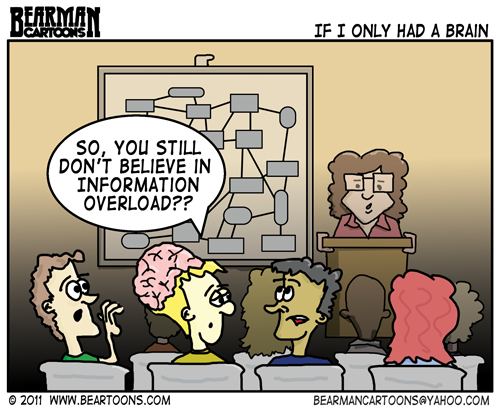
Some people who attend public lectures upon natural philosophy, with the expectation of being much amused and instructed, go home with sensations similar to those of the poor Eskimaux; they feel that they have had too much of every thing. The lecturer has not time to explain his terms, or to repeat them till they are distinct in the memory of his audience.[16] To children, every mode of instruction must be hurtful which fatigues attention; therefore, a skilful preceptor will, as much as possible, avoid the manner of teaching, to which the public lecturer is in some degree compelled by his situation. ~Practical Attention: Chapter 3 by Maria Edgeworth (Pg 73) [Pg3 of the word document]

Another view that has become increasingly popular in recent years is called the selection-for-action view.... attentional limitations should not be attributed to a limited capacity or mechanism. Instead, the limitations are byproducts of the need to coordinate action and ensure that the correct stimulus information is controlling the intended responses. ~Attention: Theory and Practice by Addie Johnson & Robert Proctor (pg 22)
____________________________________________________________________________________
       
          Proctor and Johnson recount a history of the study of attention and its importance. They break up the study of Attention into five periods, beginning with the philosophical pre-psychology period and ending with the modern age of fMRI's and PET scans that are able to reproduce full three dimensional renderings of the brain. They discuss how the views of attention went from thoughts of animal spirits and humors swimming through the rippling hills of the brain to internal capacities and abilities of developing minds. The main question becomes, "How should attention be interpreted?"
Yet some things never change...
          The viewpoint that Proctor and Johnson is an interesting one. They say that, "attentional limitations should not be attributed to a limited capacity or mechanism." This means that instead of attention loss being blamed on natural, biological limits. Instead they say, "the limitations are byproducts of the need to coordinate action and ensure that the correct stimulus information is controlling the intended responses." In layman terms, loss of attention is caused by the coordination of thoughts or objects being received and their related appropriate actions. Thus not a limit in capacity or how much time attention can be held but in how many thoughts or objects that can be mentally processed at once.

          This is very contradictory from the views of Edgeworth who tells of a natural ceiling to how long or complex a thought may be. This is an a theory that instead gives a natural limit to mankind and thus shows a more clear evolution in thinking as time goes on. However this also does not allow multitasking to be taken into account in a clearly definable way. This division in theories are not just scientific in thought but also allow for philosophical undertones. Proctor and Johnson leave an interpretation of complexity and unlimited human possibilities. Edgeworth's on the other hand is open to a more realist approach or set boundaries that will shift over time and mutation. However, both ideas are allowable and undefinable at this time without a clear winner. How to measure and define attention is important, but if one loses att.....
SQUIRREL!!!

Any-who, attention is important for furthering human knowledge, but by understanding how attention works one can streamline how to teach effectively and maximize attention. By better understanding attention maybe we can finally figure out why reddit, Wikipedia, and Facebook are so addicting.


Thursday, January 12, 2012

First Reading - Postulation and Placement: Finding the "Mind" in the Brain


A Circle round divided in four parts
Hath been great Study 'mongst the men of Arts; 
Since Archimed's or Euclid's time, each Brain 
Hath on a Line been stretched, yet all in Vain; 
And every Thought hath been a Figure set,
Doubts Cyphers were, Hopes as Triangles met; 
There was Division and Subtraction made, 
And Lines drawn out, and Points exactly laid, 
But none hath yet by Demonstration found
The way, by which to Square a Circle round:
For while the Brain is round, no Square will be, 
While Thoughts divide, no Figures will agree.
And others did upon the same account,
  Doubling the Cube to a great number mount;
But some the Triangles did cut so small, 
Till into equal Atoms they did fall:
For such is Man's curiosity and mind,
To seek for that, which is hardest to find.
~Margaret Cavendish's The Circle of the Brain cannot be Squared


What else am "I"? I will use my imagination. "I" am not that structure of limbs which is called a human body. "I" am not even some thin vapour which permeates the limbs- a wind, fire, air, breath, or whatever I depict in my imagination; for these are things which I have supposed to be nothing. Let this supposition stand; for all that I am still something. And yet may it not perhaps be the case that these very things which I am supposing to be nothing, because they are unknown to me, are in reality identical with the "I" of which I am aware? ~Descartes' Mind as Consciousness pg 22

 Bonnet concluded that it implied that body and soul could not be two distinct and separate substances but that animate beings constituted what he called an ‘être mixte’ (6). Julien Offray de La Mettrie also seized on this implication in his mid-century works, l’Homme Machine  (1747) and Traité de l’âme  (1751) (see Smith, 2002a). He concluded, like Bonnet, that the division of creation into two parts – body and soul – was absurd. Both, he writes, were created together, at the same instant, as if ‘by a single brush stroke’ (de La Mettrie, 1745, p. 2). To think otherwise was nothing more than a casuistry designed to throw dust into the eyes of the watching theologians (6). But this sort of panpsychism has, of course, tricky implications. Does all matter have this ‘dual aspect’? Leibniz, at least, recognised this implication and was content to allow his fundamental units – the monads – to possess both attributes. ~C.U.M. Smith's Brain & Mind in the 'Long' 18th Century pg 20


       The 18th century is a point of many important happenings of science and the arts. Smith discusses that the 18th century should not be limited by dates arbitrarily picked but organized by the start and finish of an era in varying realms of knowledge. He sights many examples of possible 18th centuries based on varying criteria and paradigms, but his main focus is on that of the mind and the "soul" or "spirit". First it discusses the nerve chords of the body and the question of them being hallow. Then it moves on to the idea of the location of the "animal spirit" and the debate of the separation or inclusion from or with, respectively, the body. Along with this was the idea of perceptions of the mind through irritability and sensibility. Finally the piece covered the thoughts on Electricity and its transmission throughout the nervous system.
      Although the history accounted by Smith is brief but wide in scope, I wanted to focus on one topic in particular. This manifests itself into one question: Where are our personalities located? This is a fundamental question of life. It is one that we have tried to solve for many years and some have tried but ultimately failed. Descartes talks about the personality (or soul) being separate from the body but in order for it to exist as an individual it must have an ability, in this case it is to think, in order to be able to actively participate in the surrounding world.


The internet is the 21st century's philosophical salon.


But even Descartes didn't know how to describe the physical entity of the personality let alone tell where it originated. He could only tell that there was an abstract thing called the soul or spirit and he said that it was of another substance than the body, which included the brain. We all know, through modern science, that the brain is not a spiritual vessel but it contains areas for controlling actions and processes. 
         Cavendish's poem makes a comment on the study of the brain throughout the 17th and 18th centuries. She tells of the study to "square the circle" or in other words to define the brain and its parts clearly.

Not to be confused with the Pythagorean Variety


It tells of how we try to reason, "every Thought hath been a Figure set" and map, "And Lines drawn out, and Points exactly laid" the brain in order to more fully understand its inner workings. However, it concludes with our failure, "But none hath yet by Demonstration found The way, by which to Square a Circle round" and while it may have been a dead end during the 17th and 18th centuries, today it is helps us formulate new ways to "Square the Circle". While new technologies allow us to delve further into the personality, the question of location is left in the realm of poets, philosophers, and students alike. 

What if indeed...